Mr Houghton
My PolicemanMr Houghton is a museum official whose authority over new projects turns Patrick Hazlewood’s privately developing portrait scheme into an institutional matter. He is introduced through lunches, workplace conversation, and rules: a familiar presence who can approve school art-appreciation sessions, refuse concerts, and insist that proposals follow proper channels. Patrick’s account also gives him a less predictable side, as Jackie Butters’s coy report of their chats unsettles Patrick’s settled picture of his superior.
Identity and Institutional Position
At a luncheon at the East Street Dining Room, Mr Houghton tells Patrick that he has been at the institution for twenty years, yet the board still regards him as a newcomer. His remark offers a glimpse of the museum’s internal hierarchy: even long service, in his account, does not necessarily secure recognition from colleagues. The lunch itself is characteristic in Patrick’s telling of Houghton’s tastes and surroundings: large plates, silver gravy boats, slow service, boiled food, and wine that is at least passable. Houghton polishes off a third glass of claret while discussing museum business, a detail that places official decisions inside an unceremonious, familiar routine.
His authority becomes clearer when he announces that he has approved Patrick’s art-appreciation afternoons for schoolchildren but will not approve lunchtime concerts. He frames the refusal as a matter of the museum’s purpose, insisting on its visual rather than aural business. The contrast shows that his oversight is not merely administrative: he distinguishes which activities belong within the institution’s remit and is willing to deny one proposal while accepting another.
The Portrait Project and Museum Protocol
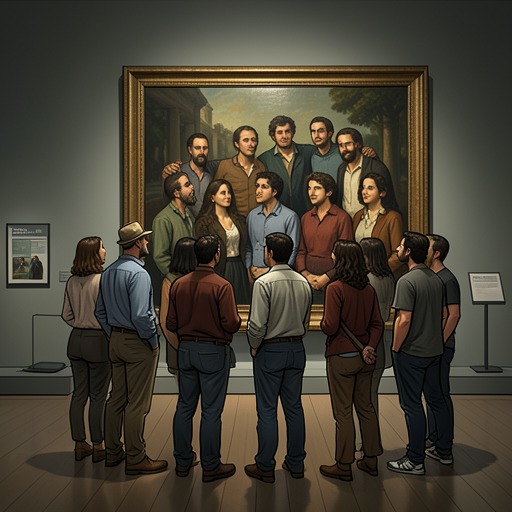
The apparent purpose of the lunch emerges only after the meal. Mr Houghton tells Patrick that Jackie has mentioned a project involving portraits of ordinary townsfolk, a project about which he had previously known nothing. He treats that omission as a problem and asks Patrick to observe museum protocol: every new project must be approved by him and may also require the board’s approval. Proper channels, he warns, are necessary to prevent disorder.
The scene makes the portrait project a test of the boundary between Patrick’s initiative and institutional permission. Patrick has been pursuing it without first bringing it formally to Houghton; Houghton’s request that he explain the scheme on their walk back indicates that he wants to hear more, but the evidence does not establish what decision he ultimately makes about it. His insistence on procedure is concrete, while Patrick’s imagined version of Houghton as a possible former Cambridge aesthete is only speculation. Patrick wonders whether Houghton once entertained unconventional interests before entering adult professional life, but cannot know whether that imagined past has any truth.
Jackie Butters and Patrick’s Perspective
Houghton’s contact with Jackie takes on a different significance when Patrick speaks with her. Jackie describes their exchanges as chit-chat and responds coyly when Patrick asks whether Houghton flirts with her; her giggle and tentative agreement suggest that she understands their conversations in flirtatious terms. This is Jackie’s characterization of the interaction, not an independently narrated account of Houghton’s intentions.
Patrick is surprised by the possibility. He pictures Houghton leaning over Jackie’s shoulder while she handles a damp sheaf of carbon copies, but that image belongs to Patrick’s imagination, not to a witnessed scene. The moment complicates the image of a rule-bound superior: the man who emphasizes formal channels may also engage in informal, personal exchanges with a subordinate. Patrick’s reaction is particularly sharp because he had not expected Houghton to behave this way; the flirtation, as Jackie presents it, briefly leaves him at a loss for words.
Characterization and Limits of the Portrait
Mr Houghton is presented through Patrick’s first-person account, which mixes observed behavior with comic judgment and conjecture. Patrick notices Houghton’s blue eyes as he explains the rules, his claret at lunch, and his carefully timed disclosure that he had already heard about the portrait project. The timing leads Patrick to conclude that the lunch had been heading toward this discussion all along. Houghton’s manner can therefore seem genial and bureaucratic at once: he invites Patrick to lunch, but uses the occasion to assert oversight.
The evidence does not settle whether Houghton’s concern is chiefly institutional order, personal authority, or both. It does show the practical effect of his position: Patrick is reminded that a project involving local townspeople cannot remain a private initiative if it is to proceed through the museum. Houghton’s significance lies in that pressure, and in the gap between the official who polices procedure and the more elusive man Patrick tries, without proof, to imagine behind it.